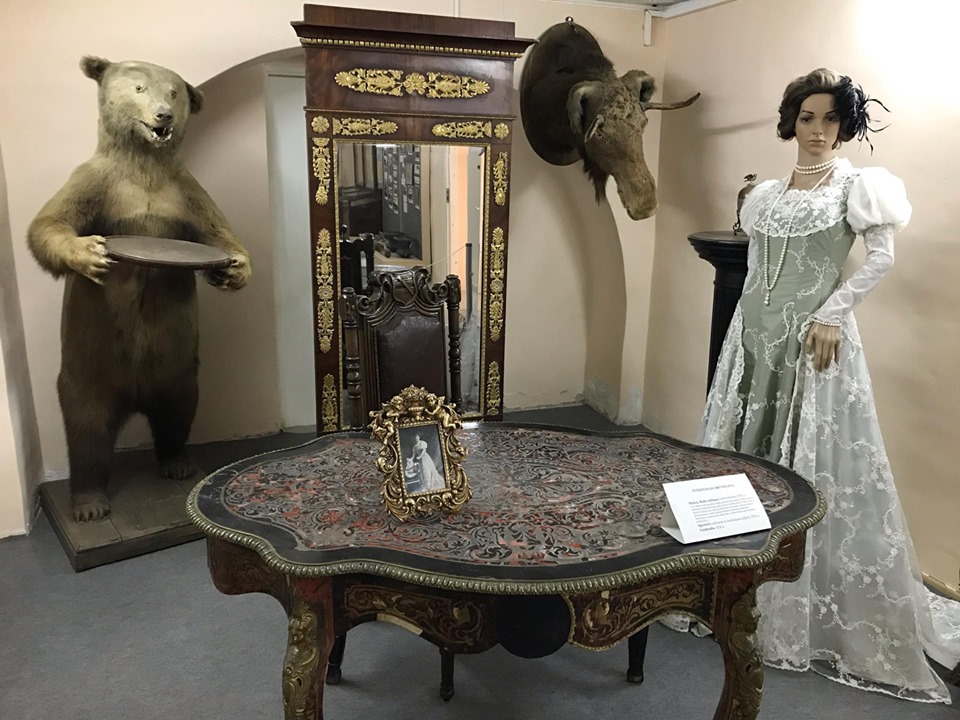
There were collections of antique objects, paintings, and hunting trophies in the manor palace of Švėkšna. The walls of the rooms were decorated with paintings (works by J. Oleškevičius, J. Rustemanas, I. Aivazovsky, and other artists). There were many German engravings, and the dining room walls were adorned with blue Delft porcelain plates. The Vilkėnas manor had fewer works of art, but it contained many ornate pieces of furniture, among which an Italian-made table stood out in particular and attracted attention.
In 1921, primary school teachers in Švėkšna decided to establish a museum in the town. Teacher A. Klumbys advised collecting exhibits. It was decided to ask Count Plater to donate an old Lithuanian grammar book to the museum. Unfortunately, these plans were never carried out.
Later, a small “museum corner” was set up in the gymnasium—just a single glass display case intended to exhibit old coins, archaeological finds, and other antiquities. A significant part of the exhibits disappeared during the war, while a few items ended up in the Švėkšna Museum established later.
In 1940, Soviet border guards moved into the Švėkšna manor. The soldiers carried the manor’s archive documents and books outside and burned them in a bonfire lit in the park. The furniture and paintings were taken away to an unknown location; their fate remains unknown to this day. A small part ended up in the “Alka” Museum in Telšiai, and a few remaining items stayed in Švėkšna—they were given to the school, and today we can see them in the Švėkšna exhibition.
In the post-war years, Lithuanian language and literature teacher Jonas Vytautas Rupšys did a great deal of work in the field of local history: in 1957, he organized many expeditions in the vicinity of Švėkšna, collecting numerous archaeological exhibits and work tools. In 1968, teacher Romualdas Pintveris set up display boards in the school library titled “The Nazi Occupation in Švėkšna” and “For Soviet Rule.”
As the school’s 50th anniversary approached, teacher Petras Čeliauskas took charge of organizing the museum. The library was moved to the villa premises, and three rooms of a small house in the park were allocated to the museum. The museum was opened in 1969, during the school’s 50th anniversary celebrations. After a few years, it had to be closed due to the poor condition of the building. Later, thanks to the efforts of the school principal O. Pintverienė, it was renovated: the roof was repaired, display cases were made, and four rooms were set up for exhibitions.
In 1993, the museum of Švėkšna Secondary School became a branch of the Šilutė Museum and was established in one of the Švėkšna manor buildings located within the Švėkšna Park area, near the Catholic church and the “Genovaitė” villa. Since 2005, it has operated in new premises in the building of Švėkšna “Saulė” Gymnasium. Many of the museum’s exhibits once belonged to the Švėkšna manor. The collection includes a rich legacy of early written heritage; one of the most valuable publications is the 17th-century Statute of Lithuania.
Tourist information services are provided to visitors of the town of Švėkšna at the exhibition.
Today, the Švėkšna exhibition consists of four different exhibition rooms:
Ethnography;
Archaeology;
Manor History;
Town History.